
Material Genesis and Industrial Manufacturing Paradigms
The environmental profile, tectonic expression, and architectural longevity of surface cladding materials are dictated by their fundamental methods of extraction and manufacturing. Natural dimension stone and sintered porcelain slabs represent diametrically opposed fabrication paradigms: the extractive-mechanical severance of geologically aged lithic formations versus the high-temperature industrial synthesis of engineered ceramic bodies.
Note from SherkatStone: As a quarry owner and international supplier of dimension stone—including dense travertines, recrystallized calcitic marbles, architectural granites, and translucent onyx—SherkatStone provides complete life-cycle transparency, technical compliance dossiers, and third-party verified physical-mechanical test data for global engineering specifications.
Natural Dimension Stone Extraction and Fabrication
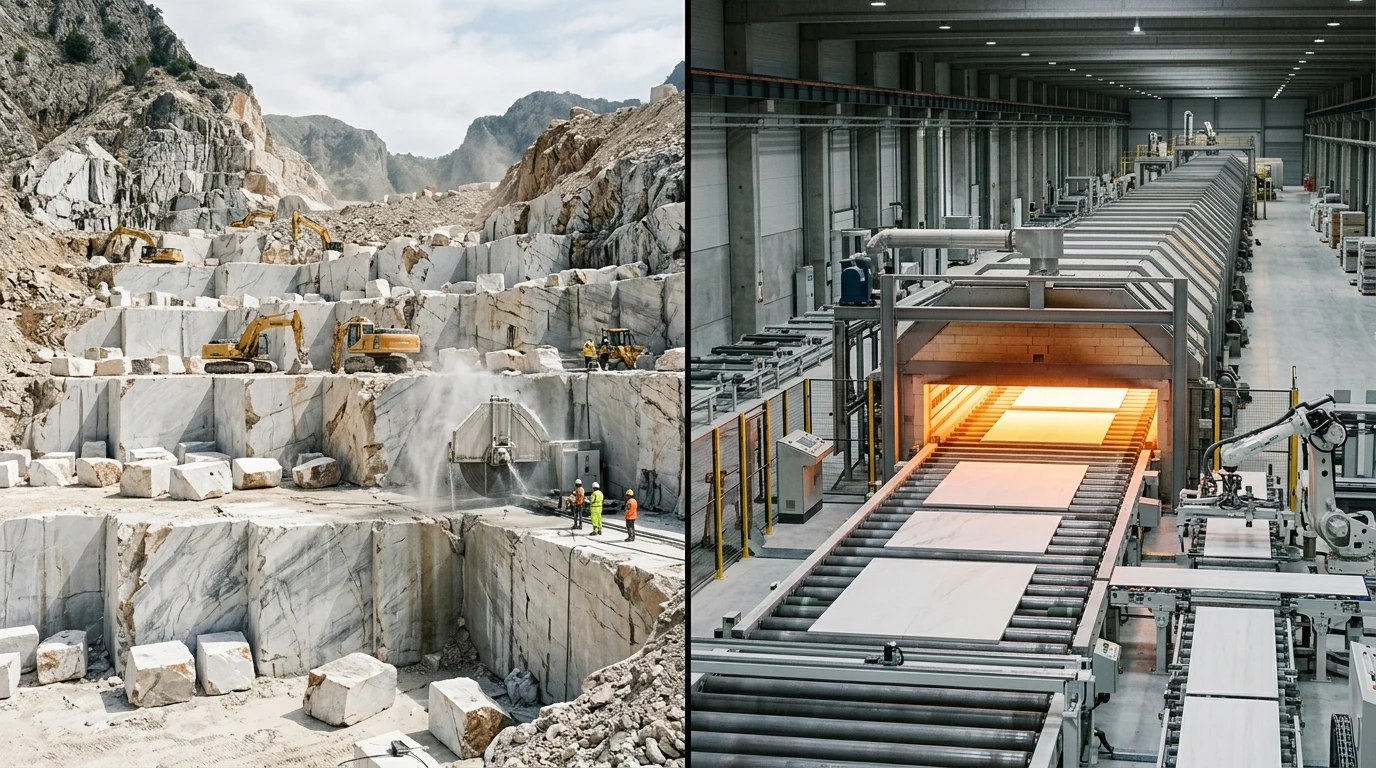
Natural dimension stone encompasses igneous rocks such as granite, metamorphic formations such as marble and quartzite, and sedimentary deposits including limestone and travertine. The industrial genesis of dimension stone relies on subtractive mechanical detachment without thermodynamic phase changes. Contemporary quarrying operations deploy automated diamond wire saws, diamond-tipped belt and chain saws, and expansive non-explosive grouts to extract rectangular primary blocks measuring up to thirty metric tons directly from the bench face. Low-velocity explosive blasting with black powder is strictly confined to clearing barren overburden, mitigating the risk of induced micro-fractures within the structural deposit.
Primary block transformation occurs at processing plants through multi-blade diamond gang saws or high-diameter circular bridge saws, sustained by continuous streams of recirculated water for cooling and dust suppression. Secondary processing calibrates slab thickness and textures the exposed surface through grinding, honing, chemical brushing, flamed thermal spalling, or abrasive polishing.
The primary industrial liabilities of dimension stone processing involve low quarry-to-slab yield efficiency and significant kerf loss. Natural geological fissures, tectonic jointing, and stylistic vein variations often limit the extraction yield to 15% to 60% of gross quarried volume. Gang sawing generates high volumes of fine mineral slurry consisting of suspended calcium carbonate or crystalline silicate micro-particles. This by-product requires industrial flocculation, mechanical filter pressing, and disposal or diversion into calcium carbonate fillers and road base stabilization. Furthermore, structurally delicate or brecciated marbles require surface stabilization using liquid epoxy resins and fiberglass reinforcement backings, introducing an external petrochemical component into an otherwise inorganic, natural substrate.
Sintered Porcelain Slab Synthesis and Compaction
Sintered porcelain slabs, frequently classified as ultra-compact sintered surfaces, represent reconstituted pyrometamorphic ceramics engineered to replicate geological metamorphic consolidation within accelerated industrial timelines. The material matrix comprises an engineered blend of natural raw minerals:
- Plastic kaolin and ball clays that provide cohesive plasticity to the unfired green body,
- Fluxing mineral agents like feldspar and nepheline syenite that depress the liquid-phase melting temperature,
- Structural quartz and cristobalite fillers that impart internal dimensional stability, and
- Inorganic mineral transition-metal oxides added for uniform through-body tinting.
These mineral constituents undergo wet milling in continuous industrial ball mills with high-alumina grinding media to achieve a fine particle distribution, followed by atomization in continuous spray-drying towers where moisture is reduced to 5% to 7%.
Forming has transitioned from static hydraulic mold presses to continuous compaction systems, such as the SACMI Continua+ platform. The granular powder bed travels across continuous conveyor belts through synchronized compaction rollers that exert dynamic hydraulic pressures between 400 and 450 kg/cm², equivalent to an effective loading force of 25,000 to 44,000 metric tons. This compaction force expels interstitial air and moisture, achieving an exceptionally high green body density before the firing stage.
Following drying in industrial humidity-controlled tunnel chambers, the dense mineral ribbon is fired inside continuous, natural gas-fueled roller kilns extending up to 160 meters in length. Over thermal cycles spanning several hours, the slabs are heated to peak sintering temperatures between 1200°C and 1280°C. Under these thermodynamic conditions, fluxing agents liquefy into a viscous glassy phase, exerting capillary forces that pull refractory quartz and clay grains into close packing. This liquid-phase sintering facilitates quartz dissolution and promotes the growth of interlaced, needle-shaped mullite crystals (3Al₂O₃ · 2SiO₂) within an amorphous vitreous matrix. The process permanently closes internal pore networks, transforming a granular powder substrate into a vitrified, non-porous monolith.
Life-Cycle Assessment and Embodied Environmental Footprint
Quantifying the environmental impacts of natural stone and sintered porcelain requires adherence to Life Cycle Assessment (LCA) standards defined under ISO 14040/14044 and EN 15804+A2. These frameworks divide material life cycles into distinct modules: extraction and manufacturing (A1–A3), transportation and construction (A4–A5), use and maintenance (B1–B7), end-of-life deconstruction and disposal (C1–C4), and circular resource recovery (D). The environmental profiles of dimension stone and sintered porcelain diverge most significantly between early production (A1–A3) and subsequent logistics and operational phases.
Cradle-to-Gate (Modules A1–A3) Dynamics
The upstream production phase highlights the primary thermodynamic contrast between the two materials. For natural dimension stone, Module A1–A3 encompasses quarry overburden management, diamond wire cutting, block haulage, mechanical gang sawing, water clarification, and surface calibration. Because stone formation was driven entirely by prehistoric geological metamorphism, sedimentation, or volcanism, industrial energy consumption during A1–A3 is limited to mechanical and electrical operations: running electric motors, operating water recycling pumps, and running sawing gantries. No fossil fuels are combusted to alter the material's mineral phase. Consequently, natural dimension limestone and granite tiles display low cradle-to-gate Global Warming Potentials (GWP-total), typically ranging from 4.7 to 8.5 kg CO₂e/m² for 15 mm limestone panels and 18.0 to 24.5 kg CO₂e/m² for dense 20 mm granite slabs.
Sintered porcelain requires substantial thermal energy during Module A3. Firing kilns and spray drying towers rely on continuous natural gas combustion, which generates direct process greenhouse gas emissions and fossil-based primary energy expenditures. In addition to kiln fuel consumption, direct emissions arise from the thermal decomposition of carbonate fractions in the raw clay.
Even when manufacturing plants implement heat-recovery networks that redirect kiln cooling air into drying rooms, thermal processing accounts for 60% to 85% of total cradle-to-gate carbon across the ceramic life cycle. Environmental Product Declarations (EPDs) indicate that thin gauged porcelain slabs (6 mm) produce a cradle-to-gate GWP of approximately 8.0 to 11.0 kg CO₂e/m². However, as slab thickness increases to 12 mm or 20 mm to satisfy horizontal countertop or self-supporting exterior facade requirements, the increased thermal mass drives the cradle-to-gate GWP to between 20.0 and 35.0 kg CO₂e/m².
Embodied Energy and Carbon Metrics
Embodied energy metrics, evaluated as non-renewable primary energy demand (PENRT) in MJ/kg and MJ/m², illustrate the thermal footprint of each material system. Natural stone requires minimal energy input per unit of mass because processing is entirely mechanical. Natural slate exhibits an embodied energy of 0.1 to 1.0 MJ/kg, limestone measures approximately 0.96 to 1.5 MJ/kg, and crystalline granite ranges between 5.9 and 6.5 MJ/kg—a variation attributable to the electrical energy required to saw through hard feldspar and quartz matrices. In contrast, sintered porcelain registers between 15.6 and 18.9 MJ/kg across its mass due to the sustained high temperatures of spray drying and kiln vitrification.
The empirical metrics comparing natural dimension stone varieties and modern sintered porcelain slabs across identical functional units are synthesized in the table below:
| Life-Cycle Assessment Parameter | Natural Jura Limestone (15–20 mm) | Natural Architectural Granite (20 mm) | Sintered Porcelain Slab (12 mm) | Heavy-Duty Sintered Slab (20 mm) |
|---|---|---|---|---|
| Installed Areal Mass (kg/m²) | 40.0 – 54.0 | 54.0 – 60.0 | 28.0 – 30.5 | 48.0 – 52.0 |
| Cradle-to-Gate GWP A1–A3 (kg CO₂e/m²) | 4.7 – 8.5 | 18.0 – 24.5 | 15.0 – 21.0 | 26.0 – 35.0 |
| Mass Embodied Energy (MJ/kg) | 0.96 – 1.5 | 5.9 – 6.5 | 15.6 – 18.9 | 15.6 – 18.9 |
| Total Primary Energy Demand PENRT (MJ/m²) | 45.0 – 75.0 | 320.0 – 390.0 | 430.0 – 570.0 | 750.0 – 980.0 |
| Primary Life-Cycle Impact Stage | Modules A2 & A4 (Haulage logistics) | Modules A2 & A4 (Haulage logistics) | Module A3 (Natural gas kiln firing) | Module A3 (Natural gas kiln firing) |
| Process Water Consumption (m³/m²) | Low (closed mechanical recycling loops) | Low (closed mechanical recycling loops) | Moderate (slip milling & glazing) | Moderate (slip milling & glazing) |

The Transportation Vector (Modules A2 and A4)
The comparative environmental advantage of natural stone is heavily influenced by transport logistics, tracked in Modules A2 and A4. Because dimension stone possesses lower flexural strength than sintered porcelain, panels must be quarried and installed at thicknesses of 20 to 30 mm to resist lateral wind and service loads, compared to 6 to 12 mm for sintered slabs. This thickness difference results in an installed dead load roughly two to three times greater per unit area for natural stone.
When dimension stone is quarried regionally—within an overland radius of 500 kilometers—its production-stage carbon advantage remains intact, offering lower whole-life carbon than imported manufactured tiles. However, modern stone procurement often follows global supply chains: quarrying blocks in Southern Europe or the Middle East, shipping them to processing hubs for gang-sawing, and freighting finished slabs across transoceanic container networks to destination building sites.
Diesel freight and maritime heavy fuel oil consumption correlate directly with cargo mass and nautical mileage. Transporting a 20 mm granite slab across international maritime supply chains adds between 15.0 and 30.0 kg CO₂e/m² in logistics-related emissions, eroding its low extraction-phase footprint. In contrast, large-format sintered porcelain slabs can be manufactured at thicknesses as low as 4 to 6 mm, substantially reducing transport mass per functional unit and mitigating logistics-driven carbon impacts on international projects.
Structural Authenticity, Tectonic Theory, and Aesthetic Integrity
Beyond quantitative life-cycle assessment metrics, evaluating surface cladding requires addressing foundational questions of architectural theory: material truth, structural expression, and surface authenticity.
Semperian Cladding Theory and the Loosian Principle of Cladding
The theoretical framework for evaluating architectural veneers originates in Gottfried Semper's nineteenth-century Bekleidungstheorie (Theory of Cladding) and its subsequent development by Adolf Loos in his 1898 essay, The Principle of Cladding (Das Prinzip der Bekleidung). Semper situated textiles and hanging carpets as the foundational spatial enclosures, asserting that tectonic frameworks—such as timber framing or stone stereotomy—exist primarily to support and suspend the spatial boundary.
Loos expanded Semper's position into a modernist ethical principle: the cladding layer must honestly communicate its own material identity and avoid simulating the physical traits of other materials. In Loos's framework, lining an interior with monolithic, highly figured marble is legitimate because the veneer displays its genuine geological origin, depth, and veining.
Conversely, applying high-resolution photographic imagery of natural marble onto a factory-produced ceramic base contradicts this principle of material truth, reducing tectonic architecture to scenographic imitation. Sintered porcelain slabs that visually replicate natural marbles, granites, or weathering corten steel decouple visual expression from underlying material reality, transforming the building surface into an aesthetic simulation rather than an authentic expression of its ceramic composition.
Through-Body Homogeneity versus Digital Inkjet Deposition
The architectural debate surrounding structural authenticity centers on material depth versus surface coating. Most mass-produced sintered porcelain slabs rely on industrial drop-on-demand piezoelectric inkjet printing to generate decorative patterns. High-resolution print heads deposit pigmented ceramic inks onto the unfired slab surface at 300 to 400 DPI.
However, this high-definition pattern is an ultra-thin surface layer that penetrates only 50 to 200 microns into the upper glaze or biscuit. Below this printed graphic lies an unpatterned, monochromatic white, grey, or beige ceramic core.
This cross-sectional separation becomes evident whenever the slab is cut, profiled, or edge-detailed. If a fabricator mills a traditional bullnose, bevel, ogee, or cove profile along the perimeter, the surface image is removed, exposing the bare ceramic biscuit beneath. To mask this limitation, installers are forced to execute mitered apron edges at forty-five degrees, joining the horizontal and vertical planes with colored adhesive resins. These mitered edges remain vulnerable to micro-chipping under point impacts, exposing the contrasting core and highlighting the material's surface-thin aesthetic layer.
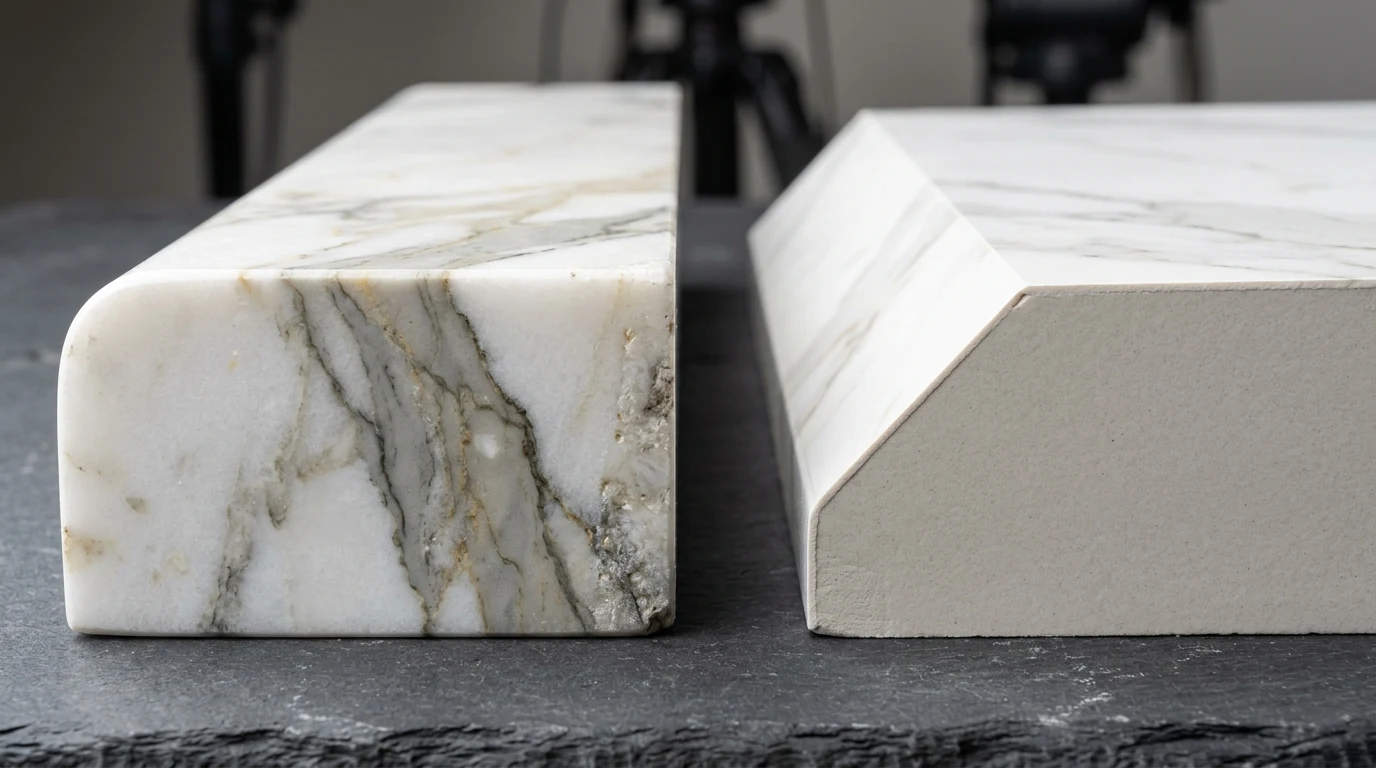
In response to this aesthetic challenge, ceramic equipment manufacturers developed continuous dry-powder multi-channel distribution systems to introduce veins through the full thickness of the slab. Systems such as the Continua+ through-body veining modules deposit colored powder streams throughout the slab's cross-section prior to compaction.
While this improves visual consistency across edge profiles, the physical flow dynamics of loose powders during compaction limit internal veining to a minimum width of approximately two millimeters. As a result, through-body veins lack the sharp, sub-millimeter definition delivered by high-resolution inkjet print heads on the surface. This variance can produce a visible mismatch between fine surface graphics and softer, more diffuse internal veins.
Natural dimension stone retains complete stereotomic authenticity. Every crystalline fissure, metamorphic fold, and fossil sedimentary bed continues uninterrupted through the full thickness of the material. Dimension stone can be fluted, gouged, relief-carved, or shaped into complex profiles without losing its structural and visual continuity.
Material Temporality: Patina, Weathering, and Repairability
Natural dimension stone functions as an open thermodynamic system that interacts continuously with its surrounding environment. Over decades of exterior exposure, natural stone develops a surface patina through chemical weathering, micro-carbonation, and rainwater dissolution. This process softens machined edges and shifts surface luster without undermining structural capacity.
When natural stone experiences mechanical damage—such as surface scratching, chemical etching from acidic precipitation, or localized impact spalling—it can be restored in situ. Architectural stone can be reground, re-honed, polished, or patched with mineral dust mixed with matching binders, preserving continuous aesthetic and structural performance across multi-century lifespans.
Sintered porcelain functions as a closed, vitrified system that does not react chemically with its environment. The non-porous, vitrified surface resists acid etching, UV fading, oxidation, and biological colonization, maintaining its factory finish indefinitely under ordinary atmospheric conditions.
However, this lack of reactivity compromises in-situ repairability. If an inkjet-decorated sintered slab chips or scratches, the damage exposes the plain interior biscuit. Unlike natural stone, the slab cannot be re-honed or reground on-site, as abrasion grinds away the thin pattern layer entirely. Surface chips can be partially stabilized using colored surface epoxies, but the photorealistic texture and fine veining cannot be recreated in the field. Consequently, severe mechanical impact or cracking typically requires the full removal and replacement of the damaged panel.
Mechanical, Physical, and Occupational Safety Metrics
Material selection involves distinct trade-offs between structural performance envelopes and occupational safety standards during fabrication and installation.
Physical and Structural Performance Parameters
The high-temperature vitrification and continuous compaction of sintered porcelain slabs produce a distinctive suite of mechanical properties:
- Flexural Strength: The flexural strength of sintered porcelain ranges between 45 and 60 MPa when evaluated according to EN ISO 10545-4 or ASTM C880 standards. This exceeds the flexural capacities of architectural granites (10 to 20 MPa) and calcitic limestones or marbles (7 to 15 MPa). Sintered porcelain's high modulus of rupture permits the installation of large, thin-format panels on open-joint ventilated rainscreen facades, withstanding high negative wind suction loads while significantly reducing dead weight on perimeter substructures.
- Water Absorption: In terms of porosity, sintered porcelain exhibits water absorption values at or below 0.05%, eliminating the open capillary networks that drive freeze-thaw damage. This low porosity prevents cyclic ice crystallization within the body, making the material resistant to spalling in cold climates. Natural granites display low absorption (0.1% to 0.4%), but crystalline marbles (0.5% to 2.0%) and sedimentary limestones (1.5% to 6.0%) absorb moisture more readily, requiring dedicated exterior drainage and joint sealing to prevent freeze-thaw micro-cracking and salt efflorescence.
- Surface Hardness & Thermal Resistance: Sintered porcelain rates at 6 to 7 on the Mohs hardness scale, demonstrating high resistance to abrasive wear, scouring, and impact scratch propagation. Because its vitrified network is fully formed in high-temperature kilns, it resists thermal shock, allowing hot kitchenware or direct flames to touch the surface without burning, cracking, or scorching. Calcitic marbles and limestones, composed primarily of soft calcium carbonate, register between 3 and 4 on the Mohs scale, scratching easily under foot traffic or steel contact and reacting readily with acidic substances. Only natural metamorphic quartzites provide equivalent scratch resistance and chemical inertness.
| Physical / Mechanical Property | Evaluation Standard | Calcitic Marble / Dimension Limestone | Architectural Granite / Quartzite | Sintered Porcelain / Dekton Slabs |
|---|---|---|---|---|
| Flexural Strength (Modulus of Rupture) | ASTM C880 / EN ISO 10545-4 | 7.0 – 15.0 MPa | 10.0 – 20.0 MPa | 45.0 – 60.0 MPa |
| Water Absorption Capacity | ASTM C97 / EN ISO 10545-3 | 0.5% – 4.0% | 0.1% – 0.4% | ≤ 0.05% |
| Mohs Mineral Hardness | EN 101 / Mohs Scale | 3.0 – 4.0 | 6.0 – 7.0 | 6.0 – 7.0 |
| Acid Etching & Chemical Reactivity | ASTM C650 / Chemical Reagents | Readily etched by mild acids | Resistant to low-concentration acids | Completely chemically inert |
| UV Radiative Degradation (Delta E) | ASTM G154 / Xenon Arc Exposure | Invariant (Delta E ≈ 0) | Invariant (Delta E ≈ 0) | Invariant (Delta E < 1 at 5,000 hrs) |
| Bulk Crystalline Silica Content | X-Ray Powder Diffraction (XRD) | < 5% by total mass | 30% – 55% by total mass | 0% – 15% (Formulation dependent) |
Occupational Health, Silica Hazards, and Regulatory Shifts
The industrial fabrication of solid surfaces—specifically dry cutting, routing, bridge sawing, and edge polishing—releases significant concentrations of Respirable Crystalline Silica (RCS). Inhaling aerodynamic particles below 4 microns in size induces accelerated silicosis, lung cancer, autoimmune dysfunctions, and progressive massive fibrosis among fabrication workers.
The severity of occupational silicosis correlates with the crystalline silica concentration and the presence of organic resin polymers in the slab matrix. Resin-bonded engineered quartz composites contain up to 90% to 95% crystalline silica bound in unsaturated polyester resins. When processed with high-speed diamond blades, thermal friction pyrolyzes the resin binder, releasing nano-scale particles of freshly fractured crystalline quartz alongside airborne volatile organic compounds. This dust composition generates reactive oxygen species that accelerate lung tissue inflammation, resulting in severe silicosis in young fabrication workers. In response to this health crisis, Safe Work Australia enacted a national ban on engineered stone containing more than 1% crystalline silica, while Cal/OSHA in the United States introduced strict enforcement standards and mandatory operational stop-work orders in non-compliant facilities.
Within this regulatory context, natural stone and sintered porcelain exhibit distinct occupational health profiles:
- Natural Dimension Stone: Varies widely in silica content based on its geological origin. Calcitic limestones and marbles are composed almost entirely of calcium carbonate (CaCO₃) and typically contain less than 5% crystalline silica, posing low silicosis risks when processed under standard wet-cutting protocols. Conversely, granites contain 30% to 55% quartz, and natural sandstones and quartzites frequently exceed 60% crystalline silica. While cutting granite releases respirable quartz, it lacks the toxic pyrolyzed styrene resins present in engineered quartz, producing dust profiles with lower inflammatory potential than composite slabs.
- Sintered Porcelain Slabs: Sintered porcelain slabs are completely inorganic and free of petrochemical resins. Their bulk crystalline silica content typically ranges between 5% and 15%, significantly lower than resin-bonded quartz surfaces. High-temperature kiln firing melts a portion of the original quartz fillers, incorporating them into a non-crystalline, amorphous vitrified matrix and reducing the proportion of free crystalline quartz in the finished product.
- Zero-Silica Formulations: To comply with zero-silica regulations, manufacturers have engineered completely silica-free sintered surfaces. Formulations like Lapitec (utilizing patented Biorite technology) replace quartz with alternative non-siliceous minerals and synthetic silicates, keeping both crystalline and amorphous silica levels below 1%. These zero-silica mineral slabs eliminate RCS hazards during fabrication while maintaining high flexural strength, scratch resistance, and thermal durability.
Circularity, Deconstruction, and End-of-Life Trajectories
As green building frameworks such as LEED v4.1, BREEAM, and international circular economy regulations prioritize whole-life cycle performance and design for deconstruction, end-of-life trajectories (Modules C1–C4 and D) have become central criteria in architectural material specifications.
Demolition and Reclaiming Paradigms
Natural dimension stone offers established, direct pathways for architectural circularity. When installed using mechanical dry-joint brackets on ventilated facades or set over sand beds as pavement, dimension stone panels can be disassembled with minimal mechanical damage. Reclaimed panels can be re-sawn, refinished, and repurposed as smaller cladding tiles, ashlar masonry, or interior paving without requiring thermal reprocessing.
When direct architectural reuse is unfeasible, crushed natural stone acts as an inert mineral aggregate for road base, concrete, or rip-rap revetments. Because it contains no synthetic additives or resins, demolition rubble can be deposited in Class DK-0 inert landfills without causing leachate contamination.
Sintered porcelain, despite its high durability during the operational phase, presents greater end-of-life recycling challenges. Thin porcelain slabs are frequently direct-adhered to concrete substrates or drywall framing using high-performance polymer-modified thin-set mortars or polyurethane adhesives to achieve adequate bond strength. During demolition, the high flexural rigidity and brittle nature of the thin slabs make them prone to shattering, yielding irregular, sharp shards adhered to mortar residue.
Separating thin, bonded ceramic shards from hardened cement mortar is labor-intensive and rarely economically viable. Furthermore, mixed ceramic-mortar rubble cannot be recycled back into raw porcelain manufacturing without altering the mineral composition of spray-drying slips. Consequently, post-consumer sintered slabs are largely downcycled into low-grade aggregate fillers or directed to mixed construction landfills. Only when installed via dry mechanical clips on demountable rainscreen facades can sintered slabs be recovered intact for reuse, though re-cutting must navigate the limitations of surface-printed patterns and exposed biscuits.
Manufacturing Scrap Recovery (Module D)
While natural stone excels in post-consumer building reuse, sintered porcelain leads in pre-consumer manufacturing scrap recovery. Automated porcelain production plants operate closed-loop recovery circuits:
- 100% of unfired green scrap—such as edge trimmings from rolling presses and green slabs broken before the kiln—is collected and reintroduced directly into wet ball mills, replacing primary raw materials.
- Fired scrap that fails dimensional or quality checks is crushed and milled into fine ceramic grog, displacing virgin feldspar and quartz in the green formula.
- Processing water is routed through closed-loop filtration tanks and centrifugal separators, achieving near-total internal water recycling with zero liquid discharge into municipal sewers.
Dimension stone quarrying and fabrication, by contrast, generate high rates of unrecovered material waste. Slurry cakes from gang sawing and wire cooling, combined with irregular quarry blocks, often accumulate in outdoor storage yards. Although stone waste is increasingly diverted to cement clinker production, agricultural soil neutralization, and industrial mineral fillers, the total volume of solid waste generated per square meter of finished dimension stone remains higher than in closed-loop porcelain manufacturing facilities.
Strategic Specification Framework and Conclusions
Choosing between natural dimension stone and sintered porcelain slabs requires balancing regional logistical networks, structural engineering loads, and the architectural intent of the building envelope:
- Regional Procurement & Authentic Geology: When a project is situated within a regional radius of approximately 500 kilometers from an active quarry and processing facility, natural dimension stone offers the superior life-cycle carbon profile. In these regional applications, natural stone relies on low cradle-to-gate embodied energy (0.96 to 6.5 MJ/kg) and modest extraction-phase carbon emissions (4.7 to 24.5 kg CO₂e/m²). This avoids the fuel-driven kiln emissions associated with sintered porcelain. Regionally sourced dimension stone also fulfills the tectonic principles of material authenticity articulated by Gottfried Semper and Adolf Loos. Its full-depth mineral veining permits complex edge profiles, three-dimensional carvings, fluting, and in-situ refinishing, while developing an authentic natural patina over its service life.
- Extreme Loads & Global Supply Chains: Sintered porcelain slabs provide an engineered alternative tailored for high mechanical demands and low-maintenance installations. With high flexural strength (45 to 60 MPa), near-zero water absorption (≤ 0.05%), and total chemical inertness, thin sintered panels (4 to 12 mm) can be installed across large ventilated curtain walls, high-traffic commercial flooring, and exterior applications subject to freeze-thaw cycles and graffiti. The reduced thickness minimizes dead load on structural building foundations and lowers transportation emissions per square meter when materials are procured internationally.
- Embodied Carbon vs Surface Limitations: These operational advantages must be weighed against sintered porcelain's high manufacturing footprint, where natural gas kiln firing generates 15.0 to 35.0 kg CO₂e/m² of cradle-to-gate embodied carbon. Furthermore, surface-printed variations remain vulnerable to material mimicry, as their micro-thin pattern layer reveals an unpatterned ceramic biscuit whenever edges are chamfered or chipped, preventing in-situ surface repairs.
- Health & Silicosis Compliance: From an occupational health and safety perspective, specifiers addressing the global silicosis crisis should favor calcitic natural stones (limestone, marble) or advanced zero-silica sintered formulations (such as Lapitec/Biorite) over resin-bonded quartz composites and high-silica stones. Zero-silica sintered slabs eliminate respirable crystalline silica hazards during cutting while delivering the mechanical durability and chemical resistance required for demanding architectural surfaces.