
Introduction
The extraction and processing of natural and decorative stones is a vital pillar of non-oil trade in resource-based economies. The unique structural and visual diversity of building stones—including marble, travertine, granite, onyx, and crystal (crystal marble)—has created immense potential for capturing target markets. A review of the industry's commercial evolution shows that stone exports reached a remarkable $186 million in the Iranian calendar year 1401 (2022-2023), indicating the high potential of this sector.
However, the strategic transition from the reductionist paradigm of selling raw materials (exporting unprocessed stone blocks) to the value-adding model of exporting processed stone in the form of slabs and tiles requires mastering an intertwined network of legal requirements, international standards, packaging engineering, lashing mechanics, and logistics optimization. Success in the highly competitive and regulated strategic destinations such as the European Union, the Commonwealth of Independent States (CIS), and the Persian Gulf countries depends on a precise understanding of the Harmonized System (HS) codes in customs, implementing compliance protocols such as CE, EAC certificates, and SABER platform processes, as well as applying precise engineering in container loading to significantly reduce transportation costs and minimize cargo damage rates.
SherkatStone Logistics Advisory: Transporting premium stone slabs across continents requires sophisticated logistics engineering. At SherkatStone, we secure every shipment using custom-built, fumigated wooden bundles and steel A-frames that meet strict ISPM-15 standards. Our logistics department manages the entire export process—from SABER and CE registration to maritime transport and border customs clearance—ensuring safe and cost-effective delivery directly to your project site.
Customs Tariff Codes (HS Code) Architecture and Duty Exemption Strategies
The structured classification of export goods in the Harmonized Commodity Description and Coding System (HS Code) is the foundation of international trade and determines the legal regime governing commercial shipments. In stone exports, selecting the correct tariff code not only clarifies the physical nature, material, and processing level of the stone for origin and destination customs, but also directly impacts the cargo's subjection to export duties and its eligibility for tax incentives. Macroeconomic policies and customs directives, particularly aiming at the years 1404 and 1405 (2025-2026), have adopted a restrictive approach towards the export of raw materials and a highly encouraging one towards high-value-added products.
In the Export and Import Regulations book, natural stones are generally divided into two main chapters, 25 and 68, based on the level of processing they have undergone. Chapter 25 includes raw stones and those with primary processing, which are directly affected by export duty policies. For instance, HS code 2515 is dedicated to marble, travertine, and other calcareous stones, with the subcategory 251511 representing completely raw blocks (unworked or simply roughly trimmed), which face the highest level of export duties aimed at preventing the outflow of national wealth. Within the same chapter, code 251512 is specific to stones that have merely been sawn into blocks or slabs (raw slabs). Although these are subject to export duties, their rates (e.g., 2% for merely sawn marble) are adjusted compared to raw blocks. A similar structure exists for igneous stones like granite and basalt under heading 2516, where roughly trimmed blocks are classified under 251611 and merely sawn slabs under 251612.
| Description in Harmonized System | HS Code | Export Duty Status | Relevant Chapter |
|---|---|---|---|
| Raw marble and travertine (unworked block) | 251511 | Subject to heavy duties (raw material export) | Chapter 25 |
| Marble and travertine merely sawn (raw slab) | 251512 | Subject to reduced duties (approx. 2% to 5%) | Chapter 25 |
| Raw granite (unworked block) | 251611 | Subject to heavy duties | Chapter 25 |
| Worked marble, travertine, and alabaster (tiles and plaques) | 680221 | Generally exempt from duties | Chapter 68 |
| Worked granite (tiles and plaques) | 680223 | Generally exempt from duties | Chapter 68 |
| Other articles of marble and travertine (polished slab) | 680291 | Fully exempt from duties (finished product) | Chapter 68 |
Conversely, Chapter 68 pertains to worked stones and finished products that have fully traversed the production value chain within the country of origin. HS Code 6802 represents fully processed building stones. Products under this code, such as 680221 (marble and travertine tiles) and 680291 (marble and travertine slabs that have undergone complex complementary operations like calibration, netting, resining, and polishing in addition to cutting), signify complete value addition and are exempt from paying any export duties. Adopting a smart strategy in shifting production lines from simple cutting to deep processing can create a massive transformation in a shipment's economics; upgrading a $100,000 shipment from code 2515 to 6802 can exempt the exporter from at least $5,000 in customs duties, drastically increasing the operational profit margin.
Slab Packaging System Engineering and Phytosanitary Requirements (ISPM 15)
The large dimensions and high density of stone slabs (which in standard sizes weigh over 300 kg per sheet) turn packaging design from a simple warehousing step into a complex challenge in mechanical engineering and logistics. Despite their high hardness, slabs are highly vulnerable to bending stresses, shear forces, point impacts, and harmonic vibrations during sea and road transit due to their unconventional length-and-width to thickness ratio. Therefore, establishing a rigid, shock-absorbing packaging structure resistant to atmospheric changes guarantees the physical integrity of the goods until they reach the final destination.
Technological Comparison: Wooden Bundles vs. Steel A-Frames
There are two fundamental architectures for securing and packing export slabs: Wooden Bundles and metal A-Frames. Choosing between these two platforms is a direct function of transit distance, the product's intrinsic value, the weight limits of the transport fleet equipment, and the buyer's hardware infrastructure for unloading.
Wooden bundles, as a traditional and highly common method, consist of sturdy wooden frames that hold slabs in batches of 8 to 15 (depending on sheet thickness). The prominent advantage of this system is the low tare weight of the supporting structure, allowing the exporter to fit a higher volume of pure stone into a given container. Additionally, wood, due to its cellulosic structure, inherently possesses a high capacity for shock absorption and dampening road vibrations. However, significant weaknesses are hidden in this method; wood is prone to swelling, deformation, and consequently a reduction in compressive strength when exposed to environmental moisture during long oceanic voyages. If the wooden structure fails under the dynamic pressures of the container, the risk of the entire bundle collapsing and causing catastrophic breakages (especially in sensitive stones like marble) is extremely high.
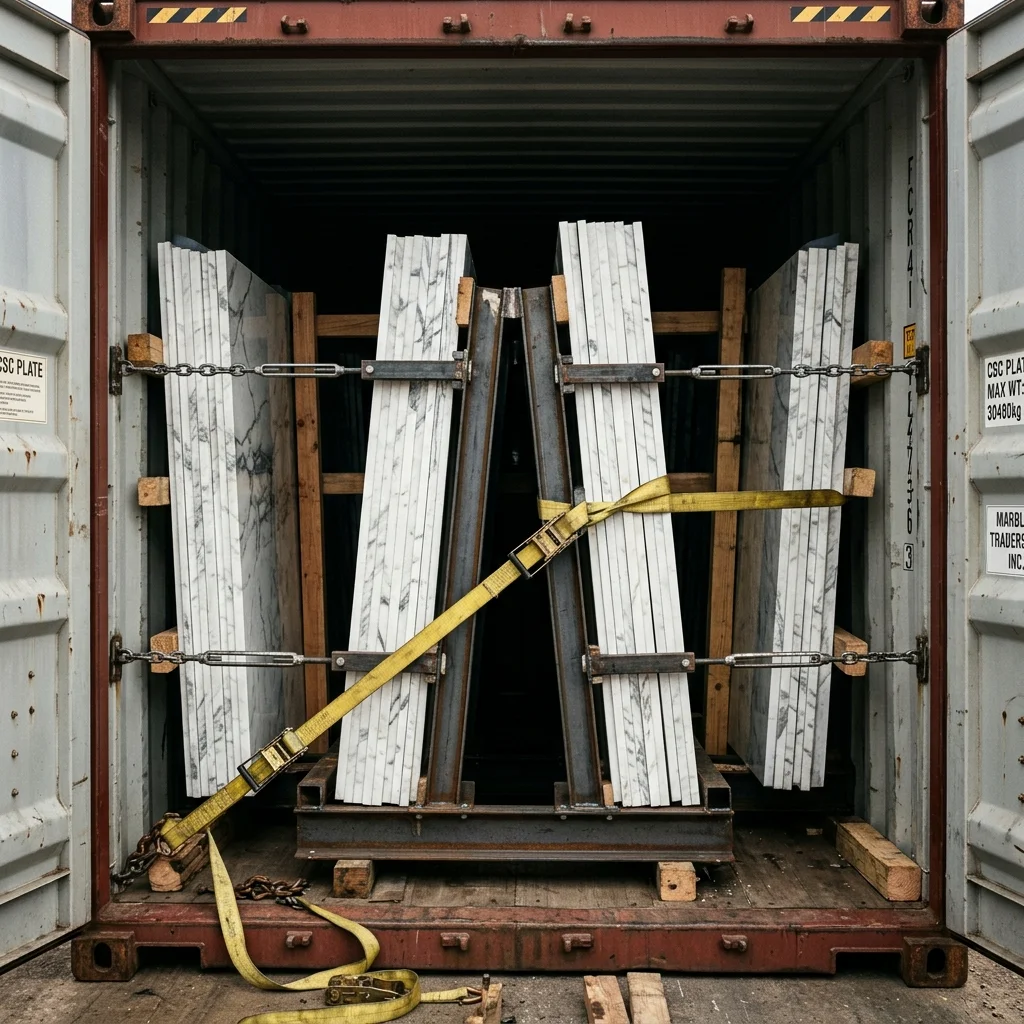
In contrast, steel A-Frames are considered a fully industrial, stable, and safe solution widely used for exports to modern markets like Europe and luxury projects in the Persian Gulf countries. These steel structures, which have a cross-section resembling the letter 'A', provide unparalleled geometric stability against bending moments and lateral forces. Slabs are symmetrically leaned on both sides of this frame and are tightly secured to the metal body using industrial metal or polymer strapping, while a layer of wood or rubber is placed between them to prevent direct contact between the stone and the steel. Although the heavy weight of the steel reduces the pure loading capacity of the container, these frames do not deform against moisture and allow for extremely safe and rapid unloading of the cargo using boom forklifts at the destination.
| Slab Thickness | Loading Capacity in Wooden Bundle (Sheets) | Loading Capacity in Steel A-Frame (Sheets) | Capacity Difference |
|---|---|---|---|
| 12 mm | 175 sheets | 147 sheets | 16% reduction in steel frame |
| 15 mm | 140 sheets | 120 sheets | 14% reduction in steel frame |
| 18 mm | 116 sheets | 100 sheets | 14% reduction in steel frame |
| 20 mm | 105 sheets | 90 sheets | 14% reduction in steel frame |
| 30 mm | 70 sheets | 60 sheets | 14% reduction in steel frame |
The data presented in the table above, based on standard loading for processed slabs (such as quartz and large natural stones), clearly shows that upgrading safety levels by using steel A-frames comes with a specific logistics cost in the form of a 14% to 16% reduction in container loading capacity. Nevertheless, for highly valuable stones such as book-matched and four-matched slabs, where any cracking leads to a severe drop in the total value of the goods, using steel frames is fully economically justified.
Phytosanitary Requirements and the ISPM 15 Global Standard
Using wood, whether as the main body of a bundle or as dunnage alongside metal A-frames, requires strict compliance with international regulations. The International Plant Protection Convention (IPPC) has established the stringent International Standard for Phytosanitary Measures No. 15 (ISPM 15) aimed at combating the global spread of forest pests, destructive insects, and plant diseases through cross-border trade.
According to updates to this standard, all wooden components used in packaging must first be completely debarked. Regulations stipulate that separate pieces of bark on the wood are only acceptable if their width is less than 3 cm, or if the total surface area of each piece of bark is less than 50 square cm, because the presence of bark can become a sanctuary for insects to lay eggs after the treatment process. After debarking, the wood must undergo one of the approved treatment methods, the most common and eco-friendly of which is Heat Treatment (HT). In this process, woods are placed in special kilns so that their core temperature is continuously maintained at 56°C for at least 30 minutes. Following successful completion of the operation, the woods are stamped with the official ISPM 15 mark (known as the wheat stamp), which includes the country's abbreviation code, the producer's identifier code, and the IPPC symbol. Furthermore, loose wooden pieces used to secure cargo inside the container require a special stamp with the prefix "DUN" (abbreviation for Dunnage) to clarify their functional nature for customs inspectors. Non-compliance of packaging with this standard at export destinations will lead to immediate confiscation of the shipment, imposition of heavy quarantine or destruction costs, and the complete return of containers to the country of origin.
Lashing Dynamics and Container Logistics Capacity Optimization
Minimizing transportation costs per square meter of stone depends on maximizing fleet capacity utilization. The high density of natural stones (marble with an approximate density of 2700 kg/m³ and granite with 3000 kg/m³) makes the main limitation in container loading the "weight bearing" capacity of the fleet and the axle load limits of transit roads, rather than volume limits.
| Allowed Container/Route Tonnage Limit | 2cm Marble Slab | 3cm Marble Slab | 2cm Granite Slab | 3cm Granite Slab |
|---|---|---|---|---|
| 20 Net Tons | 346.1 sqm | 230.8 sqm | 311.5 sqm | 207.7 sqm |
| 22 Net Tons | 380.8 sqm | 253.8 sqm | 342.7 sqm | 228.5 sqm |
| 24 Net Tons | 415.4 sqm | 276.9 sqm | 373.8 sqm | 249.2 sqm |
| 26 Net Tons | 450.0 sqm | 300.0 sqm | 405.0 sqm | 270.0 sqm |
The table above is calculated by factoring in an approximate 7% addition for the packaging structure's weight (Tare Weight). Analyzing this data shows that precise logistics planning and selecting shipping lines that allow loading up to 26 tons in a 20-foot dry container can significantly improve transport efficiency and enable the exporter to ship 450 square meters of marble slabs in one shipment. However, road and rail limitations in European and CIS countries might not permit the transit of containers weighing over 22 tons, which requires prior coordination with international forwarders.
Loading Mechanism and Cargo Stabilization (Lashing) Inside the Container
Slab loading operations are primarily carried out in standard 20-foot dry closed containers or Open Top containers. Open Top containers allow for rapid and exceptionally safe loading via overhead cranes and reduce the risk of the cargo hitting the container's roof or walls, but their rental and sea freight costs are considerably higher. On the other hand, for loading 3.5-ton wooden bundles into standard closed containers, using extended boom forklifts with a minimum capacity of 4 tons and an 8 to 10-foot reach radius is an undeniable technical necessity.
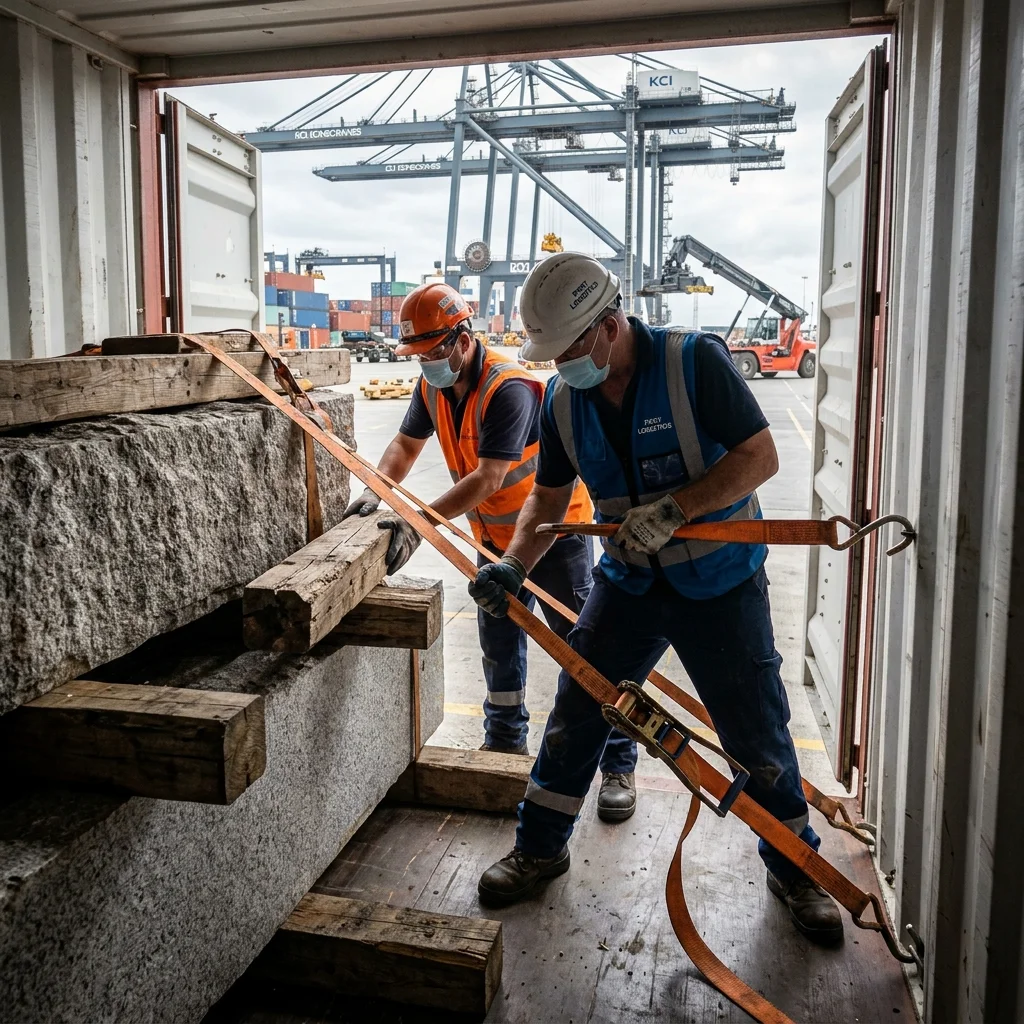
Once the bundles or A-frames are stationed inside the container, the critical lashing process begins to neutralize dynamic forces (braking acceleration, centrifugal forces on curves, and ocean wave turbulence). The cargo structures must be distributed at the container's center of gravity and placed completely symmetrically on both sides of the walls. Cargo stabilization is achieved through a combination of wooden dunnage wedged and secured in the empty spaces between the load and the container walls, along with a network of ratchet straps, steel cables, and chains connected to the lashing rings on the container floor. To prevent scratching on the polished surfaces of slabs due to microscopic vibrations during transit, inserting thick plastic films, shock-absorbing foam sheets, or industrial cardboard in the space between each stone sheet is a standard packaging requirement.
Compliance Standards and Regulatory Requirements in Strategic Markets
Accessing developed markets is not possible merely by offering visual product quality; it requires passing through robust regulatory barriers and proving product safety against international standard metrics.
EU Market: Transitioning from CE Mark to Digital Product Passport (DPP)
In the European Economic Area, natural stones and related products are governed by the Construction Products Regulation (CPR 305/2011), and affixing the CE safety mark on them is a legal, non-negotiable requirement. The presence of this mark guarantees that the good fully complies with harmonized European standards (hEN).
| Type of Stone Product | Harmonized European Standard (hEN) | Assessment System (AVCP) | Key Test Indicators |
|---|---|---|---|
| Slabs for Cladding | EN 1469 | System 3 or 4 | Flexural strength, water absorption, frost resistance, petrographic analysis |
| Modular Tiles | EN 12057 | System 3 | Flexural strength, slip resistance, surface quality, dimensional tolerance |
| Slabs for Floors and Stairs | EN 12058 | System 3 | Abrasion resistance, slip resistance, load-bearing capacity |
| Rough Blocks | EN 1467 | Exempt from CE | Compressive strength, density (only for secondary processing uses) |
The table above clarifies the classification of standards applied to stone products based on European directives. Obtaining the CE mark requires conducting a series of physical and mechanical tests in accredited laboratories (Notified Bodies). For example, the flexural strength test in cladding slabs (EN 1469) is of paramount importance because facade stones must withstand dynamic wind pressures and bending moments caused by their own weight. The results of these tests are compiled in a legal document titled "Declaration of Performance" (DoP). Exporters who affix the CE mark on packaging without providing a DoP will be prosecuted for commercial fraud, and their shipments will be turned back from European borders.
Europe's regulatory outlook indicates profound changes regarding environmental sustainability. By mid-2026, new requirements based on sustainable development will be implemented, making it mandatory to provide a "Digital Product Passport" (DPP) and an "Environmental Product Declaration" (EPD) for construction materials. These digital documents are obliged to provide full transparency of the stone's life cycle, greenhouse gas emissions, Global Warming Potential (GWP) resulting from extraction to resining operations, and even the carbon footprint in the logistics chain. Companies that do not implement mechanisms for extracting energy consumption data in their production lines will, in the very near future, be excluded from construction projects, government tenders, and green building certification systems like LEED and BREEAM in the EU.
Eurasia and Russian Federation Market: Centralized EAC and GOST Standards
The Eurasian Economic Union (EAEU)—comprising the Russian Federation, Belarus, Kazakhstan, Armenia, and Kyrgyzstan—has established an integrated conformity assessment system. In this region, classic and national standards like GOST have been merged with the Eurasian Conformity (EAC) certification system within the framework of the union's technical regulations (TR CU / TR EEU). The EAC mark certifies that the product meets the minimum safety and quality requirements established and can circulate freely within the customs territory of these five countries.
For natural stone slabs in this region, compliance with the metrics of the GOST 9479-2011 standard (and its predecessor GOST 9479-98)—which outlines the specifications for blocks and stone products for architectural, facade, and memorial uses—as well as the GOST 9480-2012 standard specific to facing slabs, is mandatory. Given the intensely cold climate of vast parts of Russia and Kazakhstan, the test for resistance to successive freeze-thaw cycles (Frost Resistance), assessed with indicators like F400, along with a precise examination of radioactive emissions (radioactivity), especially in igneous stones like granite and Gabbro-Diabase, are absolute priorities for inspection agencies in these countries. The process of obtaining the certificate of conformity must be pursued through legal representatives or bodies stationed in the Eurasian economic zone, and the EAC mark must be printed legibly and indelibly as a square with dimensions of at least 5 by 5 mm on the slab labels or accompanying documents.
Persian Gulf Markets: SASO Requirements and SABER Platform in Saudi Arabia
Megaprojects and metropolitan infrastructure development in the Arab countries of the Persian Gulf have created an insatiable demand for building stones in slab dimensions. To secure its imports, the Kingdom of Saudi Arabia has implemented the strictest regulatory frameworks managed by the Saudi Standards, Metrology and Quality Organization (SASO).
The legal export of stone to Saudi Arabia is contingent upon registration and approval from the comprehensive electronic platform "SABER," which was fully integrated with the FASAH customs clearance system in 2020. The conformity assessment of natural stones is conducted under the document "Technical Regulation for Building Materials - Part IV: Bricks, Tiles, Ceramics, Sanitary Ware and Related Products". This system includes two sequential executive stages:
1. Product Certificate of Conformity (PCoC): In this stage, which typically costs over 500 Saudi Riyals, stone samples, laboratory test reports, and product technical specifications are reviewed by Third-Party Assessment Bodies to ensure compliance with strength metrics, non-emission of hazardous chemical substances, and safety. This certificate is valid for one year.
2. Shipment Certificate of Conformity (SCoC): After obtaining the PCoC, an SCoC must be acquired for each separate export batch by paying a tariff of approximately 350 Saudi Riyals. This certificate requires uploading shipping documents (bill of lading, precise packing list, commercial invoice) and clear images of product packaging showing information labels (preferably in Arabic, including the manufacturer's name, country of origin, and safety warnings) affixed to them.
Any discrepancy between the data registered in SABER and the physical characteristics of the incoming containers will result in the shipment being rejected, the imposition of heavy demurrage fees at Saudi ports, and a negative score for the supplier in the central system.
Logistics Architecture and Geopolitical Transit Corridors in Iran
Structural advantages in Iran's geopolitical geography have provided a rich network of combined sea, rail, and road transport corridors connecting to target markets. Selecting the border customs and transport method is a determining variable in managing the time and costs of exporting stone slabs.
| Logistics Route | Main Customs / Border Terminal | Export Target Region | Dominant Transport Mode |
|---|---|---|---|
| Southern Maritime | Shahid Rajaee Port (Bandar Abbas), Bushehr Port | Europe, Persian Gulf countries, India, China | Ocean Freight with container ships |
| Northern Maritime | Caspian, Amirabad, Anzali Port | Russia (Astrakhan, Makhachkala), Kazakhstan | Multimodal transport with Ro-Ro and container ships |
| Northwestern Land | Astara Customs, Jolfa Customs, Nordooz Customs | Caucasus region (Azerbaijan, Armenia), Russia | Road transit with flatbed and curtain-sided trailers |
| Northeastern Rail | Sarakhs Border Terminal, Incheh Borun, Lotfabad | Turkmenistan, Central Asia, Moscow, and St. Petersburg | Low-sided freight wagons and containers on wagons |
| Western Land | Bazargan Border | Turkey, transit to Eastern and Central Europe | Trucks and international road transit |
The strategic routes table above shows that for exporting stone to distant destinations like Europe or neighboring Arab countries, the Shahid Rajaee port complex (Bandar Abbas) as the beating heart of Iran's maritime trade, is the safest and most economical platform for loading containers carrying slabs onto ocean-going vessels.
Exports to the Russian Federation and CIS countries increasingly rely on the International North-South Transport Corridor (INSTC). Astara border customs in Gilan province and Nordooz adjacent to Armenia are the main arteries for the road fleet. However, transporting massive and super-heavy stone shipments via railway lines using the capacity of terminals like Sarakhs and Incheh Borun is an optimal and safer solution for accessing the strategic depths of Kazakhstan and Russia. Additionally, Multimodal Transit through northern Caspian ports like Caspian and Anzali bypasses road traffic bottlenecks and accelerates cargo delivery to Volga ports. The strategic Bazargan border also remains the main highway for transferring stone slab shipments to the Turkish market and utilizing that country's infrastructure to transit shipments into the heart of Europe.

Conclusion
Establishing a powerful export structure in the stone industry requires the convergence of engineering knowledge, mastery of international trade law, and agility in logistics operations. Adopting a deep processing strategy instead of raw material sales creates a robust protective shield against fluctuating export duty policies. Transitioning packaging lines from traditional bundles to metal lashing networks and A-frames guarantees the physical survival of precious slabs during global transit stresses. Ultimately, taking the lead in implementing compliance standards such as issuing Digital Product Passports (DPP) for Europe, aligning with strict EAC regulations in Eurasia, and systematically adhering to SABER guidelines in the Persian Gulf will transform domestic companies from mere raw material suppliers into strategic partners and top-tier players in international construction projects.