
Introduction to Surface Finishes and Processing
Surface processing of natural dimension stone governs the physical interface between structural stone geology and the built environment. The selection of a specific surface finish alters fundamental architectural and engineering parameters, including specular reflectivity, chromatic saturation, tactile relief, dynamic coefficient of friction (DCOF), capillary absorption rates, and atmospheric weathering resistance.
A rigorous specification framework requires an understanding of how distinct mechanical abrasive sequences, percussion fracturing, thermal spalling, profile engraving, and chemical etching alter both siliceous and calcareous mineral structures.
Note from SherkatStone: As a specialized supplier and global exporter of premium Iranian natural stones—including high-density travertines, recrystallized marbles, granites, and onyx—SherkatStone provides precision multi-axis CNC surface profiling, diamond abrasive honing, and custom architectural surface treatments engineered to international ASTM, EN, and ANSI safety standards.
Processing Kinematics and Micro-Surface Engineering
The conversion of a raw sawn stone slab into an engineered architectural finish relies on controlled mechanical friction, differential mineral erosion, impact-induced microfracturing, thermal crystal expansion, or selective chemical dissolution.
Abrasive Planetary Grinding and Polishing
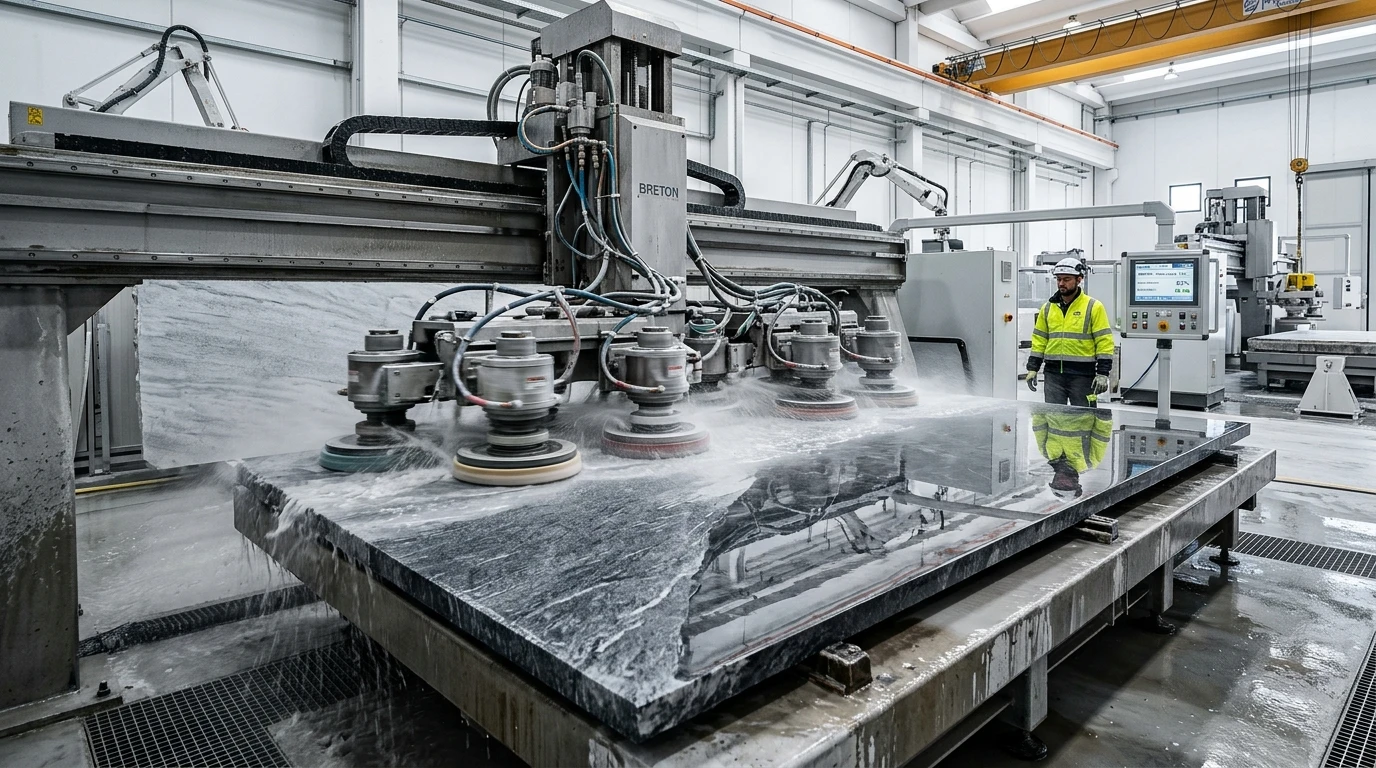
The transition from a primary gang-sawn or wire-sawn slab face to a refined planar finish is achieved through sequential abrasive grinding using diamond-impregnated metal-bond and resin-bond planetary discs under continuous water deluge.
Polished finishes require a systematic progression across the abrasive grit spectrum, beginning with coarse 50-grit diamond tooling to eliminate saw striations, and advancing sequentially through 100, 200, 400, 800, 1500, and culminating at 3000-grit buffing heads. This mechanical abrasion levels surface asperities to sub-micron tolerances, forming a specular reflection plane that reflects up to 90% of incident light.
This optical planarization intensifies chromatic depth and highlights intrinsic geological veining, fossil inclusions, and crystalline textures. The micro-abrasive polishing action mechanically peens and compacts the immediate surface pore structure, slightly reducing topical fluid penetration rates relative to unfinished slabs. However, this specular plane magnifies scratch patterns, pedestrian traffic wear tracks, and acid etching on calcareous stones.
Honed finishes interrupt the abrasive diamond sequence at intermediate grit stages, typically between 400 and 800 grit, before specular glaze forms. The resulting plane is flat and velvety smooth with a matte or low-satin sheen that disperses ambient light across a diffuse refraction field. By eliminating high-gloss reflectivity, a honed finish conceals everyday abrasive foot-traffic wear, minor scratches, and topical calcite etching. Because the microscopic pore network is not compacted by high-grit buffing compounds, honed surfaces exhibit an open capillary structure that absorbs fluids more readily, requiring deep-penetrating impregnating sealers.
Differential Abrasive Brushing and Weathering
To achieve tactile relief without sacrificing the structural integrity of the slab, fabricators use flexible mechanical texturing techniques that follow the underlying mineral distribution of the rock.
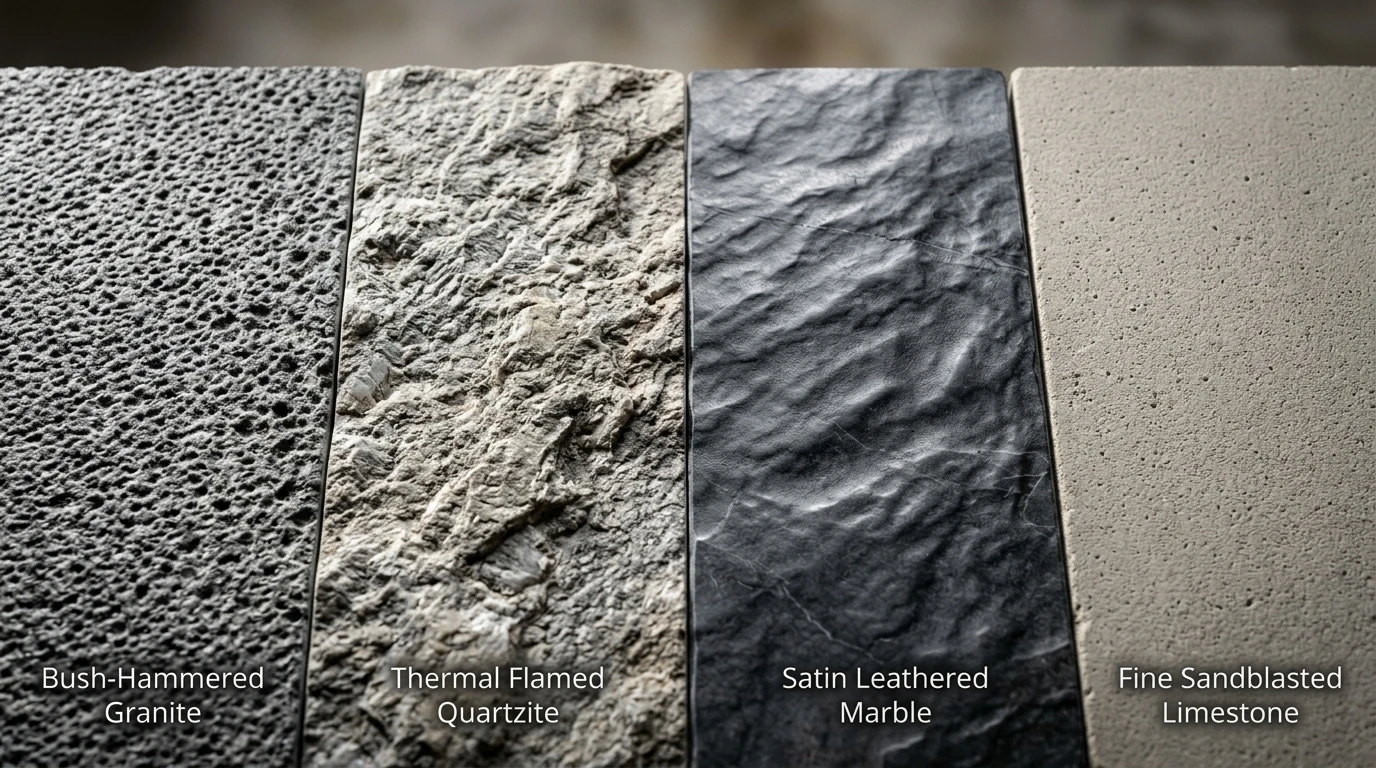
Leathered finishes (also known as brushed or satin-textured finishes) are produced by running heavy rotary brushes fitted with diamond-impregnated silicon carbide or synthetic filaments across an initially sawn or honed slab under high water pressure. The flexible diamond bristles abrade softer geological components (such as calcite, chlorite, and micas) while deflecting around harder crystalline structures (such as quartz and feldspar).
This differential mineral erosion yields a subtly undulating, pebbly topography with a warm, low-sheen luster. On dark granites, quartzites, and marbles, diamond brushing intensifies base color saturation without creating mirror-like reflections. The resulting contoured surface masks fingerprints, grease smudges, and water spots, while offering higher slip resistance and lower everyday maintenance than polished surfaces.
Tumbled and antiqued finishes are produced by placing cut-to-size dimensional stone tiles inside rotating or vibrating industrial tumblers charged with water, silica sand, and abrasive ceramic or granite media. The tumbling action mechanically rounds sharp cut edges, blunts crisp corners, and distresses the face, producing an aged, weathered aesthetic well-suited for classic paving and modular mosaic formats.
High-Impact Percussion and Thermal Processing
Heavy-duty exterior paving and extreme wet environments require mechanical aggregate interlock and deeper surface profiles to ensure pedestrian and vehicular traction.
Bush-hammered finishes are produced using pneumatic, hydraulic, or automated machine heads fitted with arrays of pyramidal carbide or diamond-tipped teeth. These impact heads strike the stone face perpendicularly at high frequencies, pulverizing the top surface into an array of microscopic craters and ridges. The resulting texture varies from fine (1/64" to 1/16" profile depth) to coarse (>1/4" relief) based on the tooth count, head spacing, and pneumatic strike velocity. Bush hammering lightens the stone's base hue due to diffuse light refraction across the shattered micro-facets, creating a rugged, high-traction surface suitable for external paving, plazas, and pool surrounds.
Flamed (thermal) finishes are engineered by sweeping an automated high-temperature oxy-acetylene or oxy-propane flame (~1,200°C to 1,800°C) across the face of a raw slab at an approximate 45-degree angle, followed immediately by water quenching. The thermal shock causes anisotropic expansion across the mineral grains. Highly crystallized quartz minerals undergo rapid volumetric expansion and thermal spalling, causing the surface crystals to shatter and pop away.
This process is exclusive to quartz-rich igneous and metamorphic stones, such as granite and quartzite. The resulting crystalline face is rough, non-directional, slightly faded in tone, and slip-resistant under continuous wet conditions.
Sandblasted finishes utilize compressed air to blast industrial corundum or silica grit against the stone face at high velocity, creating a uniform, fine-grained stippled matte surface that softens color contrast while improving surface traction.
Waterjet finishes use ultra-high-pressure water streams (30,000 to 60,000 PSI) to selectively wash away softer matrix particles without generating the thermal micro-cracking associated with open flames, preserving the natural color vibrancy and crystalline matrix of the stone.
Profile Tooling, Linear Grooving, and Cleavage
Dimensional stone surfaces can be modified with linear tooling and controlled fracture techniques that emphasize shadow relief and architectural rhythm.
Grooved, fluted, and raked finishes are produced using multi-blade diamond slitting saws or multi-axis CNC profile cutters. Parallel channels are cut into the face at fixed depths, widths, and center-to-center spacings across sawn, honed, or polished stone blanks. Fluted profiles feature concave internal curves, whereas ribbed surfaces utilize raised convex linear bands.
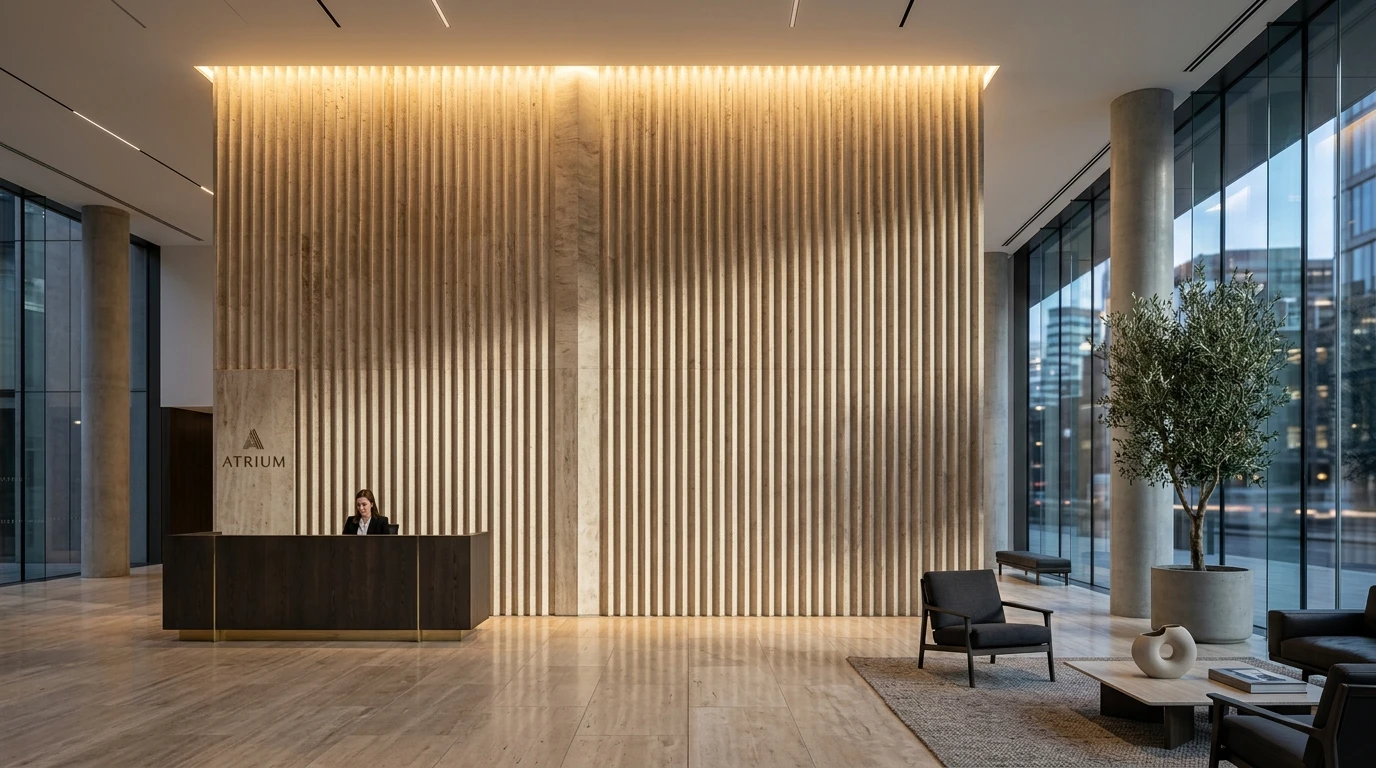
Beyond providing directional slip resistance on stair nosings, entrance thresholds, and pedestrian ramps, grooved finishes introduce deep shadow lines. When installed vertically on building facades and interior feature walls, these linear textures create an optical illusion of height; horizontal installations widen visual perception across expansive foyers and lobbies.
Split face and chiseled (pitched) finishes use controlled mechanical wedge cleavage along the natural bedding planes or rift axes of the rock. Hand-pitching tools or hydraulic guillotine splitters strike the arris of a sawn edge, producing an irregular, three-dimensional fractured surface that displays the raw mineral structure of the quarry face. This rugged relief is common in exterior base cladding, retaining walls, and rustic architectural facades.
Acid-washed finishes involve washing calcareous stones (such as marble, limestone, or travertine) with controlled baths of dilute hydrochloric (muriatic) or organic acids. The chemical reaction dissolves the calcium carbonate matrix:
CaCO₃ + 2HCl → CaCl₂ + H₂O + CO₂ ↑
This chemical dissolution mutes the specular surface sheen, highlights natural fossil and vein relief, and produces an antique, soft-touch satin texture.
Tribological Performance, Slip Resistance Metrics, and Standardized Testing
Slip resistance is a primary technical metric when specifying natural stone for horizontal walking planes. The international building sector relies on standard tribological test methodologies to establish safety baselines across wet, dry, and contaminated operational environments.
ANSI A326.3 Dynamic Coefficient of Friction (DCOF)
The American National Standard ANSI A326.3 (American National Standard Test Method for Measuring Dynamic Coefficient of Friction of Hard Surface Flooring Materials) establishes a five-category product use classification system using automated digital tribometers (such as the BOT-3000E):
- Interior, Dry (ID): Hard-surface flooring intended for interior areas that remain dry under standard conditions (e.g., commercial office corridors, boutique retail floors, residential living areas). Requires dry DCOF validation (≥0.42) when tested under laboratory parameters.
- Interior, Wet (IW): Flooring intended for interior spaces subject to occasional water or clean moisture exposure (e.g., residential kitchen floors, commercial entry foyers equipped with walk-off systems, public restrooms without showers). Mandates a minimum wet dynamic coefficient of friction of DCOF ≥ 0.42 when tested using a standardized 0.05% sodium lauryl sulfate (SLS) solution.
- Interior, Wet Plus (IW+): Manufacturer-declared classification for interior surfaces subjected to continuous water exposure, standing water, or barefoot traffic (e.g., commercial communal showers, indoor pool perimeters, spa steam rooms, locker rooms).
- Exterior, Wet (EW): Manufacturer-declared classification for exterior level walking surfaces subject to rain, snowmelt, and weather exposure (e.g., outdoor plazas, pool decks, uncovered exterior walkways, patio areas).
- Oils/Greases (O/G): Manufacturer-declared classification for industrial or commercial environments exposed to oils, greases, or automotive fluids (e.g., commercial kitchen cooking lines, automotive service bays, food processing plants).
DIN 51130 German Ramp Testing Framework
The European DIN 51130 standard measures the angle of slip failure for an operator wearing standardized treaded safety footwear walking across an oil-lubricated inclined test ramp, deriving an "R-rating" from R9 to R13:
- R9 (6° to 10° angle): Basic slip resistance suitable for dry interior environments, residential living rooms, and private entries.
- R10 (10° to 19° angle): Intermediate slip resistance suitable for public restrooms, commercial hallways, and covered residential patios.
- R11 (19° to 27° angle): High slip resistance recommended for external residential paving, public entrance steps, and wet commercial zones.
- R12 (27° to 35° angle): Very high slip resistance specified for exterior public pool surrounds, inclined ramps, commercial kitchens, and light industrial facilities.
- R13 (> 35°): Extreme slip resistance required for heavy industrial zones, abattoirs, and steep external access ramps.
Surface Finish Performance Comparison Matrix
| Surface Finish Type | Primary Mechanical / Chemical Action | Optical Sheen & Visual Character | Dynamic Friction Range (Wet DCOF) | DIN 51130 Ramp Rating | Primary ANSI A326.3 Category |
|---|---|---|---|---|---|
| Polished | Sequential diamond grinding/buffing to 3,000 grit | Specular Mirror Gloss; full color depth | <0.35 (High slip hazard when wet) | R9 | ID (Interior Dry Only) |
| Honed | Diamond grinding arrested at 400–800 grit | Satin to Matte; diffuse reflection, no glare | 0.42–0.50 (Meets basic wet floor threshold) | R9 – R10 | IW (Interior Wet) |
| Leathered / Brushed | Diamond-tipped abrasive filament wire scouring | Low-sheen textured; pebbly tactile relief | 0.45–0.55 (Enhanced tactile traction) | R10 – R11 | IW / IW+ |
| Bush-Hammered | High-impact multi-point carbide percussion strikes | Uniform micro-cratered relief; lightened tone | >0.60 (High mechanical grip) | R11 – R12 | EW / IW+ |
| Flamed (Thermal) | 1,200°C+ thermal torch spalling | Rough crystalline fracture; faded tone | >0.60 (High wet traction) | R11 – R12 | EW / IW+ / O/G |
| Sandblasted | Compressed pneumatic abrasive blast impact | Fine, uniform stippled matte; softened color | 0.50–0.60 (Moderate-high traction) | R10 – R11 | IW+ / EW |
| Grooved / Fluted | Diamond blade multi-slitting or CNC profiling | Directional linear channels; pronounced shadow | Variable (>0.60 transverse to grooves) | R11 – R13 (Profile dependent) | EW / IW+ / Ramps |
| Split Face | Hydraulic wedge percussion cleavage along rift | Rugged 3D quarried relief; extreme texture | N/A (Predominantly vertical cladding) | R12 – R13 (Paving formats) | Vertical Walls / EW |
| Acid-Washed | Chemical dissolution via muriatic/organic acids | Satin antique relief; soft eroded texture | 0.45–0.55 (Smooth non-slip) | R10 | IW / IW+ |
Petrographic Compatibility and Material Behavioral Physics
Surface processing interactions depend directly on the mineralogical and chemical composition of the stone. Applying mechanical or thermal treatments without matching the underlying petrography risks micro-structural fracturing, chemical decomposition, or aesthetic failure.
Siliceous versus Calcareous Stone Performance
Siliceous dimension stones (including granite, quartzite, sandstone, and slate) are composed predominantly of silica (SiO₂) and silicate minerals like feldspars and micas. These stones exhibit a high Mohs hardness (6 to 7), high flexural strength (modulus of rupture > 12 MPa), and strong chemical resistance to acidic substances. Their thermal stability and crystalline interlocking make them suited for high-temperature flaming, heavy mechanical bush hammering, and diamond grooving without loss of bulk structural integrity.
Calcareous dimension stones (including marble, limestone, travertine, and onyx) consist primarily of calcium carbonate (CaCO₃) or calcium-magnesium carbonate (CaMg(CO₃)₂). These stones feature lower Mohs hardness (3 to 4) and react readily with acidic solutions. Subjecting calcareous stone to thermal flaming induces thermal decomposition and calcination:
CaCO₃ + Heat → CaO + CO₂ ↑
This reaction causes the surface matrix to crumble into calcined powder. Consequently, texturing on marbles and limestones must use non-thermal methods, such as diamond abrasive brushing (leathering), waterjetting, mechanical bush hammering under water lubrication, sandblasting, or controlled acid-washing.
Travertine Morphology and Void Mechanics
Travertine forms through terrestrial geothermal precipitation, creating an internal network of macroscopic voids and degassing channels. Architectural specifications require determining whether the material is processed in a filled or unfilled condition:
- Filled travertine: Involves filling surface voids with color-matched cementitious grouts, polyester resins, or structural epoxies before final honing or polishing. This produces a solid, cleanable plane suitable for high-traffic interior floors, commercial lobbies, and food preparation areas.
- Unfilled travertine: Preserves the exposed natural cavernous voids, which are then honed, brushed, or cross-cut. While offering a textured rustic aesthetic, unfilled travertine installed in exterior freeze-thaw zones must meet low water absorption parameters (<0.5% target). This ensures that water trapped within open, unfilled pockets does not induce frost-wedging, cracking, or surface spalling during seasonal freeze-thaw cycling.
Architectural Specification Matrix and Environmental Zoning
Selecting the appropriate surface finish requires aligning technical slip metrics, environmental exposure, ambient lighting conditions, and maintenance capabilities with the programmatic demands of the space.
Interior Residential, Hospitality, and Commercial Interiors
Current interior architecture favors textured, low-glare surfaces over high-gloss finishes.
- General interior flooring: For living rooms, public corridors, and hotel lobbies, honed finishes provide a durable walking plane that diffuses natural light and conceals traffic lane wear.
- Vertical feature installations: Polished slabs are best reserved for bookmatched accent walls, elevator surrounds, and fireplace fascias. In these vertical, non-traffic applications, high specular gloss amplifies room illumination, emphasizes subtle mineral veining, and requires only light dry-dust maintenance without risk of pedestrian slip hazards.
- Culinary and countertop surfaces: For kitchen countertops and vanity tops, leathered finishes offer a practical alternative. The closed, diamond-brushed surface resists liquid absorption better than open-pore honed stone while concealing fingerprints, oil smudges, minor knife scratches, and crumbs. For polished calcareous countertops (such as Carrara or Calacatta marble), regular applications of fluorochemical impregnating sealers are required to guard against acidic etching from citrus, vinegar, and wine.
- Wet interior zones: In master bathrooms, public restrooms, and shower pans, ANSI A326.3 mandates a minimum wet dynamic coefficient of friction of DCOF ≥ 0.42 (Category IW). Polished stone flooring must be avoided in these locations due to slip risks when wet. Specifiers should select honed or brushed slabs for bathroom floors, and small-format tumbled mosaics (where dense grout joint patterns provide mechanical traction), sandblasted limestone, or flamed granite for shower floors.
Exterior Facades, Paving, and Urban Landscapes
Exterior stone must withstand freeze-thaw cycles, solar UV degradation, atmospheric soot, and foot and vehicular traffic under wet conditions.
- Plazas, terraces, and pool copings: Thermal flamed granite and bush-hammered basalt or limestone provide stable wet traction, meeting DIN 51130 R11 to R12 and ANSI Category EW requirements. The rough crystalline facets prevent aquaplaning under foot, even during heavy rain or around pool edges.
- Ramps and transit stairways: Grooved or raked finishes offer enhanced directional slip prevention. Parallel linear grooves cut into stair nosings or across ramp inclines provide mechanical grip perpendicular to the direction of pedestrian travel.
- Building plinths and foundation cladding: Split face, heavy bush-hammered, or hand-chiseled stones protect building foundations against ground-level impacts and moisture splashback. The textured relief masks weathering patterns, air pollution accumulation, and efflorescence.
- Feature facades and modern cladding: CNC-machined fluted or grooved panels create architectural depth, allowing directed grazing light to cast sharp linear shadows across the stone facade.
Capillary Ingress, Sealing Science, and Maintenance Protocols
The mechanical alteration of a stone's surface changes its microscopic pore network, altering fluid uptake rates, chemical reactivity, and sealer bonding characteristics.
Sealing Chemistry: Penetrating Impregnators versus Topical Coatings
Film-forming topical coatings (such as acrylics, polyurethane lacquers, or sacrificial waxes) create a solid polymer barrier over the stone surface. While they provide an initial gloss and block surface liquid contact, topical sealers alter slip resistance when wet, wear down unevenly under foot traffic, and trap rising sub-slab moisture vapor, which can cause clouding, hazing, and delamination. As a result, the Natural Stone Institute (NSI) advises against topical coatings for exterior installations and dense honed or polished surfaces.
Penetrating (impregnating) sealers rely on sub-micron fluorochemical or silane/siloxane polymers carried in solvent or water-based solutions. These reactive compounds penetrate the stone's capillary pores, coating the internal pore walls to lower the surface energy. This creates an oleophobic and hydrophobic barrier that repels water, oils, and grease without filling the pore structure or inhibiting vapor transmission.
- Honed and Sandblasted Surfaces: Require higher-volume applications of penetrating sealers to saturate the open capillary network left by intermediate abrasive grinding.
- Leathered Surfaces: Require moderate sealing; the diamond brushing process leaves an undulating surface that sheds liquids more readily than flat honed stone.
- Flamed and Bush-Hammered Paving: Require breathable, oil-and-water-repellent siloxane impregnators to prevent freeze-thaw water retention and automotive fluid penetration without altering the matte, weathered appearance of the stone.
Maintenance Engineering and Decontamination Protocols
Maintenance schedules must be tailored to both the petrographic composition of the stone and its surface profile depth.
- pH-Neutral Cleaning: Calcareous stones (polished or honed marble, limestone, travertine) should be cleaned exclusively with pH-neutral stone detergents. Acidic cleaners (such as vinegar or muriatic dilutions) attack the calcite matrix, degrading polished surfaces into dull planes and pitting honed finishes.
- Textured Surface Washing: Textured, grooved, and split-face profiles collect atmospheric particulates, dirt, and cleaning residues within their channels and micro-craters. Cleaning these textured surfaces requires cylindrical nylon-bristle mechanical scrubbers, controlled low-pressure washing, or wet vacuum extraction rather than flat-surface microfiber mops.
- Poultice Stain Extraction: Deeply set fluid stains (such as motor oil on flamed granite pavers or red wine on honed marble) require extraction using an absorbent chemical poultice. A reactive solvent or chemical reagent is blended with an inert absorbent powder (such as diatomaceous earth, kaolin clay, or talc) to form a smooth paste. The poultice is applied across the stained zone at a thickness of 1/4" to 1/2", covered with polyethylene film to retard rapid evaporation, and allowed to draw for 24 to 48 hours. As the carrier solvent evaporates, it pulls the stain out of the stone's capillary network and traps it within the drying poultice cake.
Engineering Directives and Specification Framework
To ensure that natural stone installations meet long-term functional, structural, and aesthetic requirements, specifiers should follow five core engineering guidelines:
- Prioritize Slip Resistance Over Gloss in Wet Areas: Polished surfaces should be restricted to low-traffic vertical installations, decorative accents, and dry interior spaces (DCOF < 0.42, ANSI Category ID). Horizontal interior walking surfaces subject to moisture require a honed or leathered finish certified to meet or exceed DCOF ≥ 0.42 (ANSI Category IW).
- Mandate High-Traction Treatments for Outdoor Environments: Exterior plazas, walkways, entrance steps, and pool decks must use thermal flamed, bush-hammered, coarse sandblasted, or grooved finishes to ensure wet traction (ANSI Category EW, DIN 51130 R11 to R12).
- Match Surface Treatments to Mineral Composition: Thermal flaming must be limited to quartz-bearing igneous stones (such as granites and quartzites). Calcareous marbles, limestones, and travertines should use mechanical brushing (leathering), waterjetting, honing, or controlled acid-washing to achieve texture without inducing thermal decomposition.
- Account for Residual Slab Thickness in Dimensional Tooling: Grooved, fluted, and pitched split-face finishes require verifying the residual thickness, structural density, and arris strength of the stone slab to prevent fracture under mechanical and seismic loads.
- Protect Surfaces with Vapor-Permeable Penetrating Sealers: Natural stone finishes—especially open-pored honed, textured, and exterior surfaces—should be sealed using deep-penetrating fluorochemical or siloxane impregnators rather than film-forming topical coatings, preserving long-term breathability, stain resistance, and slip-resistance performance.